
Counting Dimes the Right Way: What a Standard Roll Really Holds
Behind a routine number lies a system collectors rely on every day.
Considering why that standard exists reveals how it is actually used in the modern financial sector.
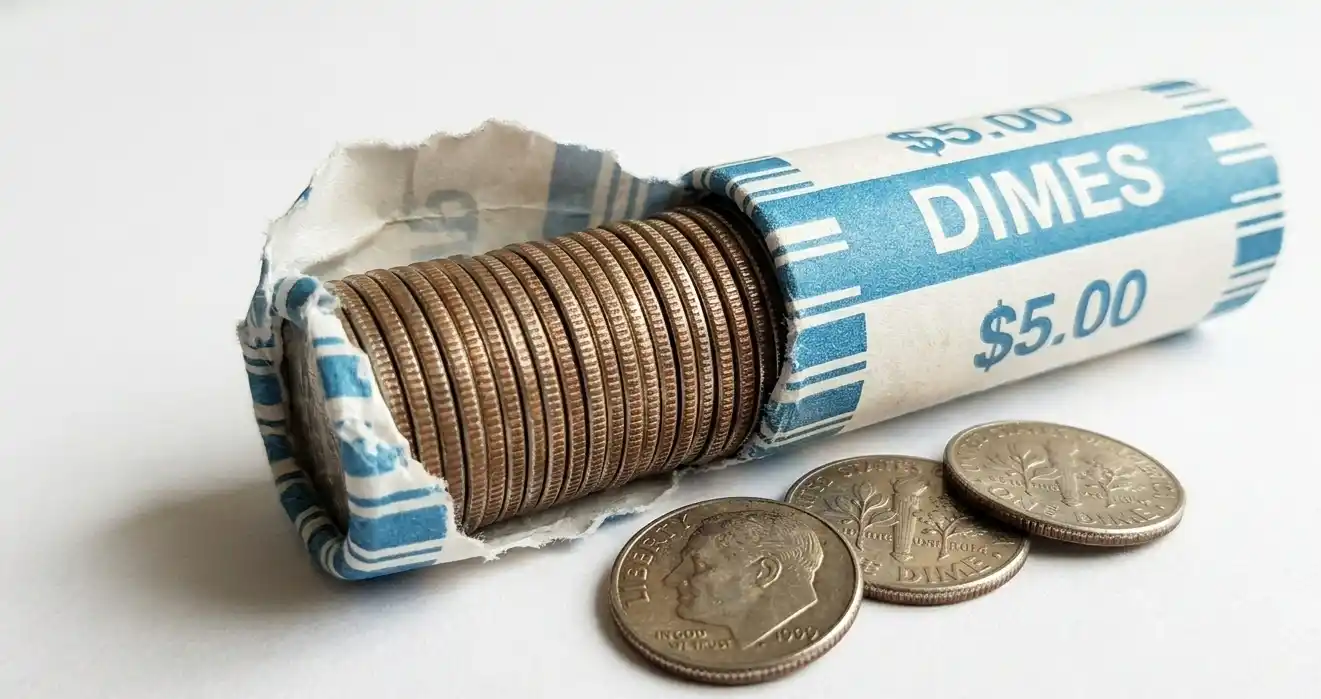
A standard roll of 10-cent coins, commonly known as dimes, follows strict Federal Reserve regulations.
Automated packaging processes eliminate deviations in the number of units inside each wrapper.
So, how many dimes are in a roll?
Item | Value |
Quantity per roll | 50 pieces |
Face value per roll | $5.00 |
Wrapper color | Green |
Coins inside the roll sit in a strictly ordered arrangement.
The packaging mechanism presses obverses and reverses tightly against each other.
Adopting this format simplifies inventory management in bank vaults.
Instead of counting individual units, employees operate using the weight and volume of standardized blocks.
Technical Specification of the Coin
A modern dime possesses a strictly regulated physical profile and metal content.
Deviations from these norms lead to the rejection of blanks at the mint.
Property | Data |
Diameter | 17.91 mm |
Thickness | 1.35 mm |
Weight | 2.268 grams |
Outer layer | Copper and Nickel |
Core | Copper |
Reeded edge count | 118 ridges |
The total weight of a full roll equals 113.4 grams excluding the weight of the paper.
Changes in physical properties caused by wear are accounted for during mass checks at cash centers.
→ Constant weight → Automated counting → Lower operational costs
Historical Transition of Metal Content
Before 1965, dimes consisted of an alloy with a high precious metal content.
The Coinage Act of 1965 changed the economic model for producing small denominations.
Coin Composition Until 1964 Inclusive:
Silver: 90%
Copper: 10%
Weight: 2.5 grams
Increasing market prices for silver made producing these coins unprofitable for the government.
Raw material costs rising above the 10-cent face value forced a change.
This led to the massive removal of silver coins from circulation by the public.
Evolution of Market Value for Rare Specimens
Auction prices depend on the preservation state and mintage rarity.
Professional grading services, including the Professional Coin Grading Service, apply the 70-point Sheldon scale.
Year and Type | Grade | 2010 Price | 2026 Price | Growth |
1916-D Mercury | MS65 | $35,000 | $43,500 | 24% |
1942/1 Mercury | MS66 | $12,000 | $16,200 | 35% |
1996-W Roosevelt | MS68 | $450 | $650 | 44% |
Annual value appreciation for coins in the highest preservation categories averages 2–4%.
Investment attractiveness stems from the small number of surviving pieces showing crisp details.
Auction Records and Critical Anomalies
Certain specimens reach extreme price points due to production errors.
Missing mint marks or doubled die strikes increase buyer interest.
1894-S Barber Dime: only 24 pieces struck, selling for $1,997,500 in 2016
1975 No S Proof Roosevelt Dime: only 2 examples known, currently valued above $500,000
1982 No P Roosevelt Dime: a common error, worth approximately $350 in MS67 condition
Market data indicates stable demand for minting mistakes.
The quantity of found specimens in circulation decreases every year.
This relates to improved quality control systems at the Philadelphia and Denver mints.
Logistics and Storage of Rolls
Coin transportation occurs in canvas bags or cardboard boxes.
A standard dime box holds 50 rolls.
Wholesale Packaging Structure: 1 Roll = $5.00 1 Box = 50 Rolls = $250.00 Box Weight ≈ 5.7 kg
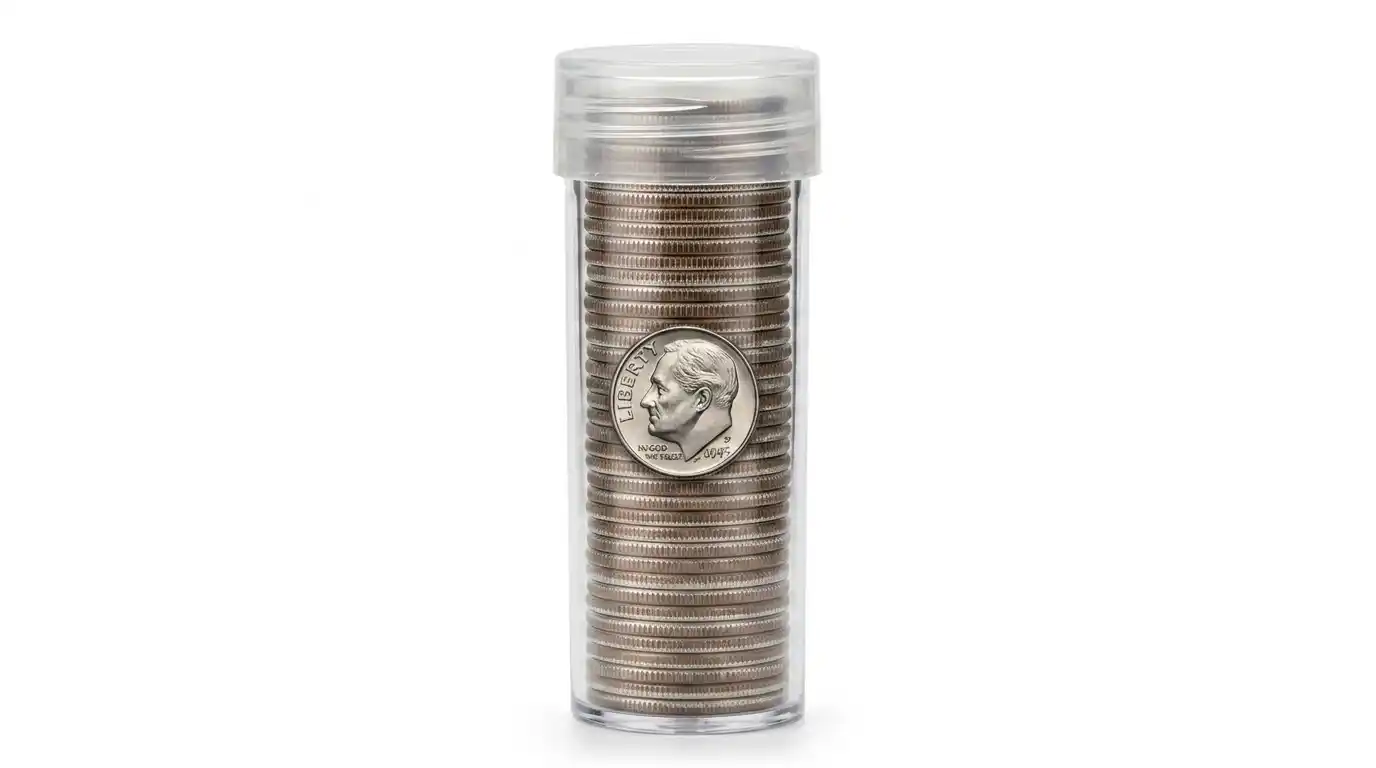
Using plastic tubes provides protection against moisture.
Oxygen causes oxidation of the copper layer in modern coins.
Tarnish appearing on silver dimes influences final expert evaluations.
Black or rainbow toning might increase or decrease the price depending on the evenness of the coating.
Classification of Dime Series
US history identifies several key periods for 10-cent coin production.
Each type features unique design characteristics.
Draped Bust (1796–1807): the first regular issues
Capped Bust (1809–1837): changing the portrait of Liberty
Liberty Seated (1837–1891): a long period using a single image
Barber (1892–1916): designed by engraver Charles Barber
Mercury (1916–1945): officially named the Winged Liberty Head
Roosevelt (1946–Present): the current coin type
The transition to Roosevelt dimes happened after his death.
John Sinnock developed the design.
His initials "JS" sit at the base of the president’s neck.
Wear Factors and Condition Classification
Coins lose weight and detail sharpness during circulation.
This remains critical when forming rolls for long-term storage.
Uncirculated: no signs of wear, retaining original mint luster
Extremely Fine: light wear on the highest points of the design
Very Fine: visible wear, but all letters and dates remain readable
Good: outlines worn down, showing only the main silhouette
Banks primarily use Average Circulated coins for forming rolls.
Collectors seek Mint Rolls obtained directly from the mint and check each coin with the free coin value checker app.
These sets preserve original luster for decades under proper temperature control.
Impact of Mintage on Value
Production volume correlates directly with market price decades later.
The Philadelphia Mint usually omitted mint marks on dimes until 1980.
The Denver Mint uses the letter "D".
The San Francisco Mint uses the letter "S", mainly for Proof sets.
Year | Mint | Mintage (Millions) | Rarity |
1949 | S | 13.5 | Moderate |
1955 | P | 12.8 | Above Average |
1955 | D | 13.9 | Moderate |
2009 | P | 96.5 | High for moderns |
Low mintage in 2009 resulted from the economic crisis.
Demand for new coins dropped during that period.
Consequently, 2009 rolls now trade at 3–5 times their face value.
This serves as an example of modern issues acquiring added value.
Market Price Dynamics for Popular Positions
Monitoring price quotes helps identify trends.
Considering the percentage change in price over the last 5 years:
1916-D Mercury Dime (G4 condition) → 18% growth
1921-P Mercury Dime (F12 condition) → 14% growth
1945-S Micro S (MS65 condition) → 4% decrease due to a large hoard hitting the market
1964 Silver Rolls → 30% growth driven by metal prices
Prices for standard circulated rolls without rare dates stay tied to scrap value.
For silver issues, the price follows a formula: face value × metal content coefficient × current silver price.
Pure silver content in a single pre-1965 dime equals 2.25 grams.
Therefore, a full roll contains 112.5 grams of pure silver.
Proof Coinage Features in Rolls
Proof coins are not intended for general circulation.
Mints strike them using specially prepared dies on polished blanks.
Such coins enter rolls very rarely, usually after the opening of gift sets.
Identifying features of Proof dimes:
Mirror-like fields
Frosted relief
No scratches typical of bag transportation
The value of a modern Proof dime averages between $2.00 and $5.00.
This represents a value 20 to 50 times higher than the face value.
Authentication and Condition Checks in Rolls
Buying sealed rolls carries the risk of replaced end coins.
This tactic, known as a "Shotgun Roll," involves placing rare coins only at the visible ends.
Professionals apply the following non-destructive check methods:
Weighing on jewelry scales accurate to 0.01 grams
Verifying the stack thickness
Using the best coin value app to confirm metal composition
A roll weight deviation exceeding 0.5 grams signals the presence of different denominations or worn pieces.
Sometimes cents or foreign coins with similar diameters end up inside.
The Role of Dimes in Modern Money Supply
Despite the growth of digital payments, the need for physical coins persists.
Dimes remain the most requested denomination for providing change.
Their small size and light weight make them ideal for logistics.
Annual production exceeds 2 billion pieces.
Distribution by mints in 2022:
Philadelphia: 1,350,000,000 pieces
Denver: 1,470,000,000 pieces
The total face value of dimes issued yearly exceeds $280 million.
This requires the production of more than 56 million standard paper wrappers.
Technological Aspects of Blank Production
The mint purchases metal sheets from external suppliers.
The process of punching out blanks leaves scrap sent for recycling.
→ Blanking → Annealing for softening → Washing → Upsetting for rimming → Striking
Every stage influences the final quality of the coin in the roll.
Small marks are considered normal for coins packaged through automated means.
These defects, called "Bag Marks," are inevitable when finished coins fall into a shared bin.
Investment Strategies Using Rolls
Some investors choose to keep coins in their original bank packaging.
This guarantees the coins have not entered circulation.
Preserving mint luster increases the liquidity of the asset.
Advantages of Storing in Rolls:
Protection against mechanical damage
Ease of accounting and transport
Buyer confidence in original mint packaging
Opening a roll might reveal a specimen with above-average striking quality.
Such finds are sent for grading to receive a plastic slab.
A certified coin costs significantly more than a coin in a paper wrapper.
For instance, a regular 2021 dime costs $0.10, but in MS68 condition, its price can reach $25.00.